If dipstrike can be measured accurately the tectonic orientation is easily mapped. O work out the angle of dip in the strike directions.
13 5 Measuring Geological Structures Physical Geology First University Of Saskatchewan Edition
Calculating Dip and Strike Using Geomatica Software High-resolution imagery and an accurate Digital Elevation Model DEM are vital for dipstrike validation.

. Use UpDown Arrow keys to increase or decrease volume. Strike and dip are one way of describing the orientation of a plane in 3 dimensions. In Figure 12 strike is E-W 090 and the dip is.
Tan 11000 5000 113 Lets say you measure 30 o the map. However a little basics can help. Dips and strikes of folded strata will tend to show systematic changes at different locations.
Please put in paragraph form. The strike of a rock is the orientation of a horizontal line drawn perpendicular to the dip. Tan tan cos Where apparent dip true dip and angle between strike and cross section.
Describe each and give specific examples use sketches if that helps. What is the difference between a dip-slip fault and a strike-slip fault. The strike is used to identify planar features on a bedrock.
Dip and strike are a method of describing the orientation of a plane in three dimensional space. Answer 1 of 4. Strike dip and direction and the angle between strike and the cross section.
What is the difference between a dip-slip fault and a strike-slip fault. Strike and dip are two references that are important for defining the attitude of any geologic feature. As nouns the difference between dip and strike is that dip is a lower section of a road or geological feature or dip can be a foolish person while strike is baseball a status resulting from a batter swinging and missing a pitch or not swinging at a pitch in the strike zone or hitting a foul ball that is not caught.
It is measured along a vertical plane perpendicular to the strike line from an horizontal plane down to the plane under consideration. It is defined as the amount of inclination of a bed with respect to an horizontal plane. A strike-slip fault is when rock moves alongside another.
Strike and dip are measurements of the orientation and slope of a rock. They are used together. It is usually applied to the orientation of tilted layers of rock.
The dip is an angle that can have any value between 0 horizontal plane to 90º vertical plane. A dip-slip fault is when the rock moves along the dip of the fault. The photo below is an outcrop seen during Malekhu field work in Dhading Nepal.
For instance information on rock attitudes depicts fold structu View the full answer. The problem can only be solved on field. Dip and strike when used together describe the orientation of a surface in three dimensions.
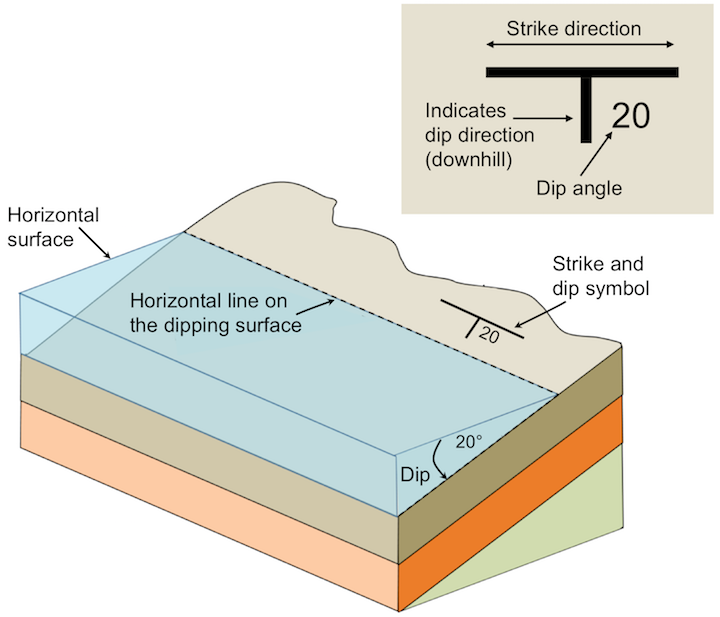
Dip is essentially an angle of inclination of the bed. Geologists use a prescribed method of determining the attitude or orientation in three-dimensional space of rock layers or any other planar geological feature eg metamorphic foliation fractures faults and tops of tabular units like formations. The dip is the angle at which the surface dips from the strike.
2 Use the bulls eye leveling bubble to make the compass horizontal while maintaining step 1 above. Dip and strike indicate the orientation of a plane at a specific location. The strike is the angle of the intersection of the plane with a horizontal surface so the strike of a horizontal plane is undefined.
Strike and dip is a measurement convention used to describe the orientation or attitude of a planar geologic feature. Geologists use these measurements to map geologic structures. The dip of a rock is the angle between horizontal and the slope of the rock.
I think you are confused how we exactly see strike dip amount and dip direction on the field. The orientation of the horizontal lines on a bed of rock is called the strike. A features strike is the azimuth of an imagined horizontal line across the plane and its dip is the angle of inclination measured downward from horizontal.
Strike is at right angles 90o to the dip direction and always has two directions such as North-South or ESE-WNW and can be measured as compass directions or bearings like 000o 180o or 045o 225o Use the model to. Two planes may have the same strike an dip. As verbs the difference between dip and strike.
Dip is always perpendicular to strike and has both a compass direction and an angle. The directions for finding strike are. Estimation of strike and dip ie the attitude of rock layers or other planar geologic structures assists geologists with building exact geologic maps and geologic cross-segments.
Use the compass rose to work out the strike directions. Describes how to determine dip and strike of folded rock layers and how to interpret geologic maps. In the example below the fold axis is horizontal and axial plane vertical.
The method involves measurement of strike and dip of the rock layers or planar features. The strike and dip geology define the position of the structure with respect to a horizontal plane and both together provide a more accurate structural description rather than only strike geology. Strike and Dip are used to refer to the orientation or a rock bed and fault.
This is measured on a vertical plane lying at right angles to the strike of the bedding see Fig. Describe each and give specific examples use sketches if that helps. 1 Place the side edge of the compass against the bedding plane.
Just as two intersecting.

Strike And Dip Wikiwand
What Are Dip And Strike Quora

The Three Basic Categories Of Faults Figure 8 Strike Direction Dip Download Scientific Diagram



0 Comments